.jpg/picture-200?_=19a96148102)
scroll down for English version
Es war schon ein gelückter Zufall, dass wir 2014 in der Mitte Berlins ein besonderes Schaufenster entdeckt haben. Das leere Quadrat markierte die Lobby eines Bahnhofs, der jahrzehntelang vermauert in einem anderen Land lag. Ideal für die Inszenierung unserer Wertekammer für zeitlose Dinge. Jedes Objekt hat seine Geschichte. Kitschkaputt geht Souvenir. Lebensarten Schickschallkarten. Die wechselnde Präsentation kaufbarer Trouvaillen und alter Naturbildtafeln ermöglicht individuelle Kulturreisen à la carte. Lücke ist eine Frage der Perspektive.
Unser Salon durchlebte die Pandemie und wurde zu einer international besuchten Schaubude. Wir freuen uns über den Transfer unikater goodlucks in alle Himmelsrichtungen, gestern erst nach London und Shanghai, und morgen schon nach Bogota, Kapstadt und Island.
Norbert und Alexandra Stück studierten Bildende Kunst in Berlin (West). Ab 2000 gestaltete das Künstlerpaar kulturelle Erlebnisräume im öffentlichen Raum und Ausstellungen im Auftrag namhafter Institutionen. Dieses Projekt wäre nicht ohne die großzügige Unterstützung eines privaten Förderers zustande gekommen.
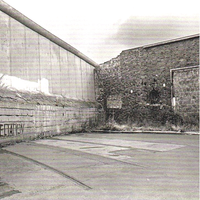
Berliner Mauer 1980
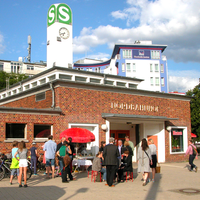
Our popshop is based in the lobby of a historical underground station, which reopened its service after the fall of the Berlin Wall. Its now over 12 years of exciting operations that Alexandra and Norbert Stück run their tiny showbox as a flexible art installation of reused stuff and auratic needs. Unique discoveries and antique images of our endangered planet tell us wonderful stories. Even the prizes are so smart you could buy them.
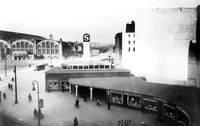
Der Bahnhof
scroll down for English version
Das Empfangsgebäude für die S-Bahn am großen Stettiner Fernbahnhof wurde 1936 nach Eröffnung des Nord-Süd-Tunnels eingeweiht (Arch. Günther Lüttich). Von hier aus gelangten die aus den Dampfzügen ankommenden Massen zum Stadion der olympischen Nazi-Spiele. Nach dem Krieg stillgelegt. 1950 Umbenennung der Station zu Nordbahnhof. Mit dem Bau der Berliner Mauer 1961 geschlossen in den Grenzstreifen an der Bernauer Straße eingebaut. Das Gebäude stand jetzt auf der Ost-Seite des geteilten Berlin, in der Hauptstadt der DDR. 1962 Sprengung der Ruine des Stettiner Fernbahnhofs. Ab 1984 passierten westberliner S-Bahnen die ostberliner Stadtmitte unterirdisch über den von Grenzsoldaten der DDR bewachten "Geisterbahnhof" ohne Halt. 1989 fiel die Berliner Mauer, das riesige Gleisgelände wurde von Grenzanlagen und Wachtürmen befreit. Auf dem Areal des Fernbahnhofs entstanden moderne Bürobauten und ein Freizeitpark. Der ehemalige Bahnhofsvorplatz wurde wieder zur Tramhaltestelle. Der in seiner historischen Form erhaltene Nordbahnhof an der Invalidenstraße ist als Architekturdenkmal geschützt. Die wechselvolle Geschichte des Gebäudes findet sich auf Plakaten in der Eingangshalle und entlang der unterirdischen Gleise.
History of Nordbahnhof
The reception building for the S-Bahn (Arch. Günther Lüttich) at the large long-distance station Stettiner Bahnhof was inaugurated in 1936 after the opening of the North-South City-Tunnel. The grand station marked the main line to the Baltic Sea Ferries and the beaches. That year the mighty steam trains discharged the masses heading directly to the stadium of the Olympic Nazi Games. The Stettiner Bahnhof has been bombed down in the Second World War. The subway tunnel served as a shelter, at the end flooded by the Soviets. By 1950 the Subway station was renamed to Nordbahnhof under East control.
With the construction of the Berlin Wall in 1961 the line was completely closed and the building incorporated into the border strip on Bernauer Straße. In 1962 the ruins of the long-distance train station Stettiner Bahnhof were demolished to gain a free borderfield. Now Nordbahnhof stood on the East side of a divided Berlin, the capital of the German Democratic Republic. In 1984 negotiations reached to open the tracks, so that subway trains could pass through the center of East Berlin underground without stopping. The West-East-West-passage through the dark "Ghost Station" was strictly guarded by East German border soldiers patrolling the platform and the tunnel. In 1989 the Berlin Wall fell and the vast railway area was freed from border facilities and watchtowers. It lasted up to 2014 to reopen the line. S-Nordbahnhof is preserved in its historical form, protected as an architectural monument. On the site of the former long-distance station modern office buildings and a leisure park were built. The former forecourt was restored as a tram stop. The eventful history of the building is displayed on posters in the entrance hall and along the underground platforms.
Übersetzung unter Verwendung von AI: Quillbot.de TH Augsburg 090626